Training A Tiny Model To Set Timers From Natural Language
Natural-language timers look like a small problem until you require exact output.
I wanted to see whether a small browser-friendly model could translate workout instructions into exact timer sequences. The interesting part was not only which model won, but how much the output format changed the result.
This request is easy for a person:
8 minute warmup, 8 minute cooldown and six steps in the middle
one minute each alternating between work and rest
But the app cannot accept "approximately right." It needs a timer sequence with the right count, order, labels, kinds, and durations.
The goal of this training session was to see whether a small browser-friendly model could translate user requests into timer plans. We started from a Qwen/Gemma-style chat model question, but the result was more interesting: the biggest gains came from changing the output language, not from choosing a larger model.
The Short Answer
Do not train a tiny model to emit JSON for this task.
Train it to emit a compact timer DSL, parse that DSL deterministically, and score the expanded timer array.
The final model target looked like this:
8m: Warmup
6alt 1m: Work | 1m: Rest
8m: Cooldown
END
That expands to the same internal timer objects the app already needs:
[
  { "label": "Warmup", "durationSeconds": 480, "kind": "warmup" },
  { "label": "Work", "durationSeconds": 60, "kind": "work" },
  { "label": "Rest", "durationSeconds": 60, "kind": "rest" },
  { "label": "Work", "durationSeconds": 60, "kind": "work" },
  { "label": "Rest", "durationSeconds": 60, "kind": "rest" },
  { "label": "Work", "durationSeconds": 60, "kind": "work" },
  { "label": "Rest", "durationSeconds": 60, "kind": "rest" },
  { "label": "Cooldown", "durationSeconds": 480, "kind": "cooldown" }
]
The model only learns the fuzzy part: map natural language to a compact command.
The parser owns the exact part: expand repeats, normalize durations, infer timer kinds, and reject malformed output.
The Metric
The useful metric was strict exact match after parsing:
- same number of timers,
- same duration for every timer,
- same kind for every timer,
- same label for every timer.
I also tracked semantic exact match, which ignores labels. That was useful for debugging, but strict exact match was the gate. A timer model that gets the intervals right but drops Plank and Squats is still wrong for the user.
What Changed The Curve
The first attempt was conventional: prepare natural-language requests and train the model to emit strict JSON.
That was the wrong target. Earlier in the session, Qwen2.5 0.5B moved from 0/40 to only 5/40 after 300 LoRA iterations on JSON output. That 5/40 score did not mean Qwen was bad. The target was making a small model spend capacity on braces, quotes, arrays, and property names.
Switching to a DSL helped, but not enough at first.
Line-by-line DSL targets like this still required the model to enumerate every repeated timer:
8m: Warmup
1m: Work
1m: Rest
1m: Work
1m: Rest
1m: Work
1m: Rest
8m: Cooldown
END
The models learned the syntax quickly. They became parseable. But they still made count errors: stop one interval early, jump to cooldown, or add an extra repeated block.
The decisive change was compressed repeat syntax:
6alt 1m: Work | 1m: Rest
That command means "emit six total timers by alternating these two atoms."
For repeated rounds:
4x 1m: Rest | 1m: Work
That means four full rest/work rounds, or eight timers total.
For generic repeated timers:
20x 10s: Timer
The parser expands and numbers them internally.
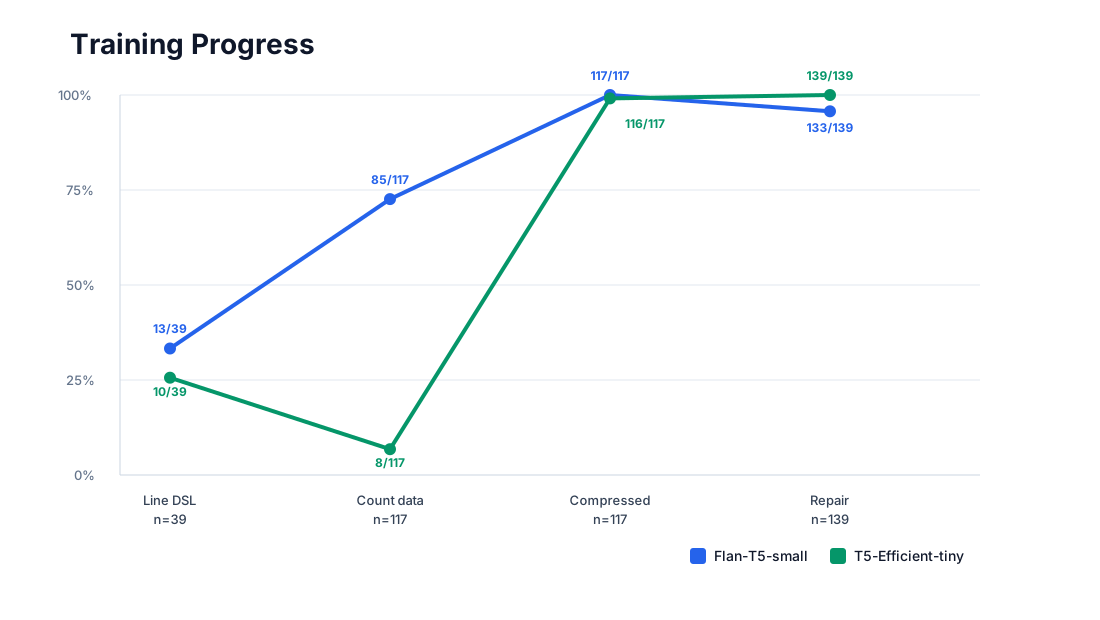
The validation set changed as the dataset got harder, so this is not one continuous scientific benchmark. It is a decision log. Each point represents the best checkpoint after a training or data-format change.
The Flan-T5-small line dips on the final point because the same compressed checkpoint was rescored on the new harder label-copy validation set. I did not tune Flan further there because tiny had become the better browser candidate.
The shape matters:
- More count examples alone helped Flan-T5-small, but hurt tiny.
- Compressed DSL fixed the long-output problem for both models.
- The final tiny gap was not counting anymore. It was label copying.
The Model Comparison
Early model comparison was useful, but only after the target was made reasonable.
With line-by-line DSL, google/flan-t5-small was the best local candidate, but the best score was only 13/39. The efficient-family models were smaller, but still weak. Tiny reached 10/39 in the early setup. That was not enough to ship.
After compressed DSL, the comparison changed . The chart that mattered was not accuracy alone; it was accuracy against model footprint.
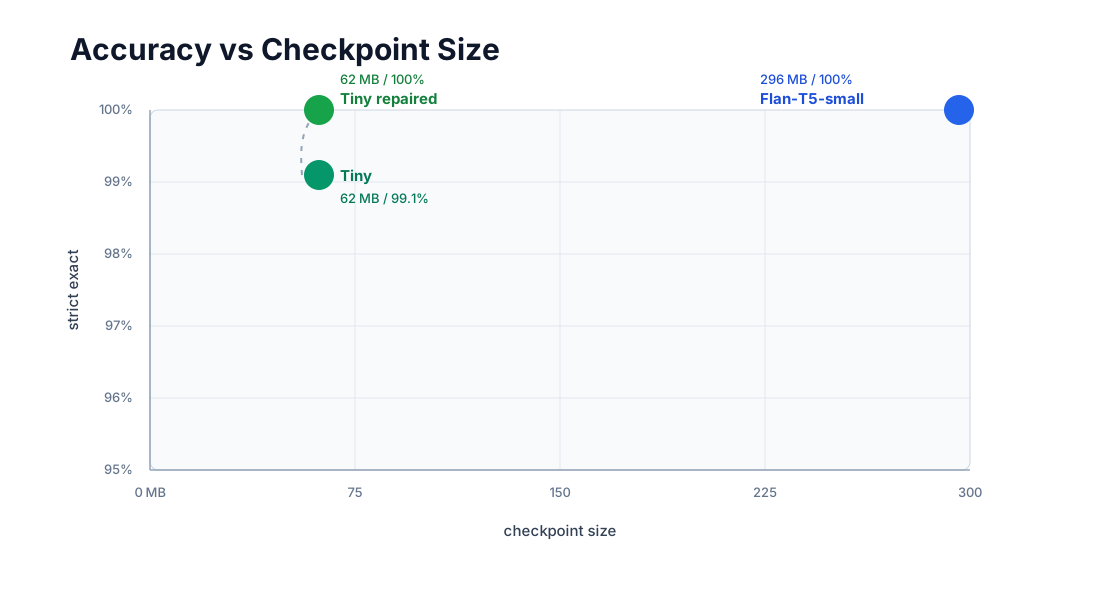
Flan-T5-small hit 117/117 on the compressed validation set. google/t5-efficient-tiny hit 116/117.
That changed the decision.
Locally, the Flan checkpoint was about 76.96M parameters and 296 MB. The tiny checkpoint was about 15.57M parameters and 62 MB.
Tiny was one validation row worse, but roughly 4.8x smaller on disk. Fixing the one tiny failure mode made more sense than switching to the larger perfect model.
The Last Failure
The remaining tiny failure was explicit label copying.
The model handled compressed count syntax, but when the input looked like:
30 seconds plank, 45 seconds squats, 1 minute rest
it produced a generic timer command instead of preserving labels:
30s: Timer
END
That made sense after looking at the dataset. The original explicit-sequence category had only five examples. Tiny had learned the dominant compressed workout patterns, but it had not learned that arbitrary exercise names should be copied.
The fix was targeted:
- add explicit label-copy examples,
- keep validation fixed,
- add train-only hint rows for the stubborn residual patterns,
- oversample
explicit-label-copyandexplicit-sequence, - continue from the existing tiny checkpoint at a lower learning rate.
The final dataset had 685 train rows and 139 validation rows. The label-copy slice added 98 train examples and 22 validation examples, plus train-only hints.
The final tiny checkpoint reached:
139/139strict exact on the augmented validation set,139/139semantic exact,39/39strict exact on the original validation set,22/22on the explicit label-copy validation category.
The fix was targeted: add the data that represents the skill the model is missing, and weight it enough that a tiny model cannot ignore it.
The Parser Became The Product Boundary
One important engineering change came out of the training work: the DSL parser could not stay as a training-only helper.
If the model is trained to emit:
5alt 45s: Rest | 45s: Work
then the app must understand exactly that grammar.
So the parser became a shared module used by:
- human timer shorthand input,
- fallback planning,
- dataset generation,
- dataset validation,
- JavaScript evaluation,
- Python seq2seq benchmark scoring.
The Python benchmark now batch-calls the shared JavaScript parser instead of keeping a separate parser copy. That matters because training numbers are meaningless if evaluation accepts syntax the app cannot execute.
What I Would Keep
I would keep this structure for any narrow natural-language-to-action model:
- Choose a compact output language.
- Make the output language deterministic to parse.
- Train the model to emit that language, not the final application JSON.
- Evaluate by executing/parsing the output and comparing real semantics.
- Add data by failure category, not by vague volume.
- Compare models only after the target is fair.
For this timer app, the compressed DSL was the actual breakthrough. Model size mattered after that, but before that the models were being punished for an output format that made counting harder than it needed to be.